


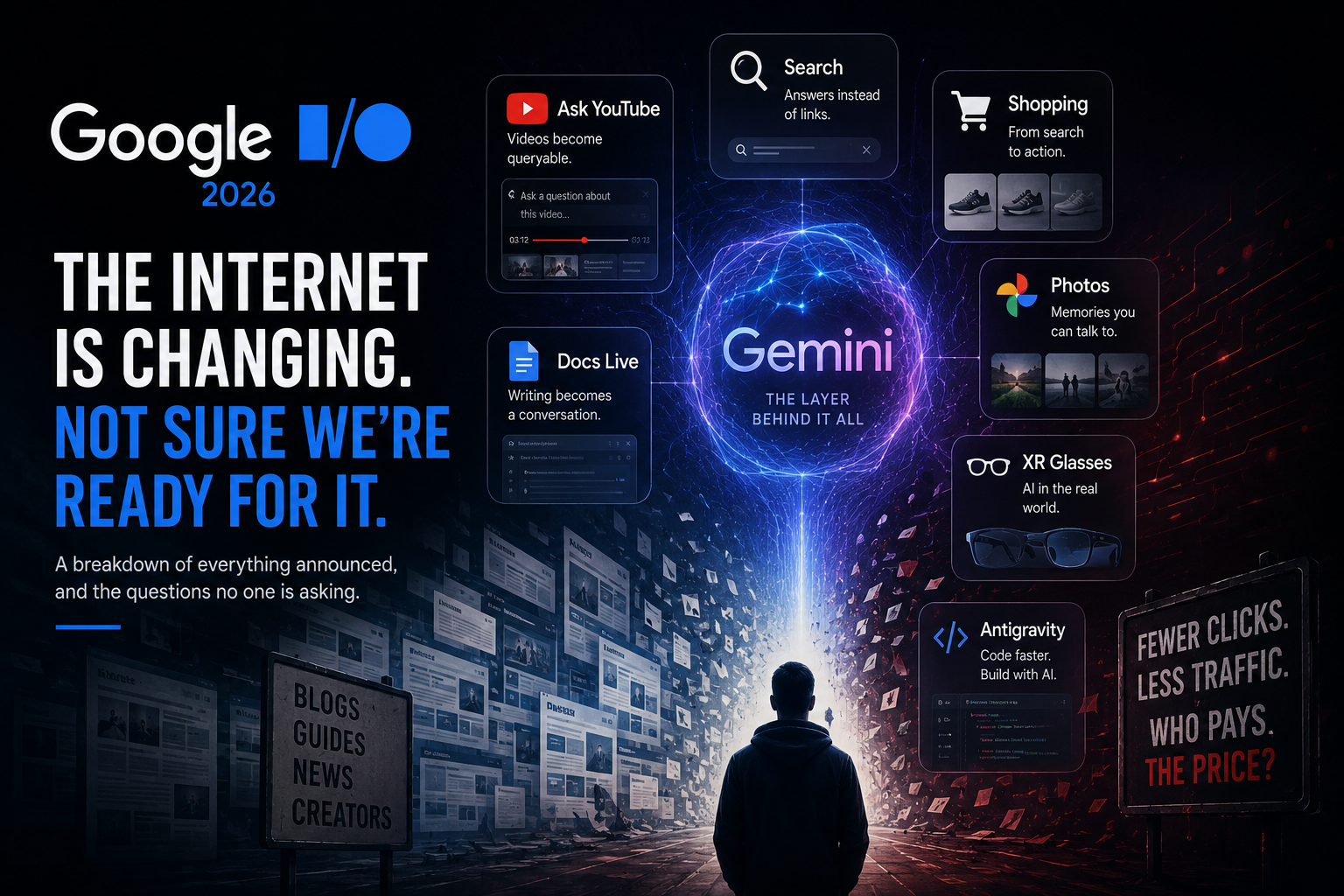
Google I/O 2026 made one thing extremely clear:
AI is no longer a feature inside Google products. It is becoming the foundation of the entire Google ecosystem.
From Search to YouTube, Docs to Photos, and even hardware like smart glasses, nearly every product announced now revolves around Gemini.
But the bigger question is not what was announced, it’s what this actually means for the internet itself.
Ask YouTube
YouTube is no longer just a video platform.

With Ask YouTube:
- Ask direct questions about video content
- Jump directly to specific parts of a video
- Get AI-generated summaries of long videos
Videos are increasingly treated less like media to watch from beginning to end and more like searchable databases users interact with through prompts. This reduces the role of the video timeline itself.
Docs Live
Google Docs is shifting from a writing tool into an AI-assisted interface.
With Docs Live:
- Documents can be edited through conversation
- AI assists with real-time writing
- Voice and text inputs are merged
Writing is no longer a fully manual process from start to finish. It becomes a system where the user and AI co-generate output.
Gemini
At the center of all these changes is Gemini:
- Gemini Omni → multimodal model (text, image, video, audio)
- Gemini 3.5 Flash → fast lightweight model layer
- Gemini Spark → always-on assistant layer
- Gemini for Science → domain-specific reasoning systems
Instead of separate AI features across products, Google is building one intelligence layer that sits across everything.
Google Search Becomes an AI Decision Layer
Google Search is being restructured.
It is moving away from a link-based system toward:
- Conversational answers
- Contextual responses
- Summaries replacing result lists
This is one of the most significant shifts because it removes the need for users to visit multiple sources to form an answer.
That has direct impact on the open web, especially blogs, guides, and informational websites that depend on search traffic.
Shopping Inside Google
Google is extending the same approach into commerce.
Instead of only showing results, it now:
- Compares products automatically
- Summarizes differences
- Highlighting recommendations
- Reducing research time
Google is moving from indexing information to interpreting information on behalf of users.
Google Photos
Google Photos is becoming a searchable memory system.
Users can now interact with their photo libraries conversationally by:
- Asking questions about past events
- Searching memories using natural language
- Generating summaries from stored content
This changes stored media from a passive archive into an interactive dataset.
Intelligent Eyewear
The XR glasses direction pushes AI into the physical environment.
Features include:
- Live translation
- Navigation overlays
- Contextual information in real time
Antigravity
On the developer side, AI-assisted development tools are being expanded further.
The direction is:
- Faster app creation
- AI-assisted coding
- Agent-based software generation
This reduces the amount of manual work required to build applications from scratch.
It also raises questions about what happens to foundational learning in software development when abstraction keeps increasing.
The Bigger Picture
This is not a collection of separate product updates.
It is a system redesign and everything is being built around a single layer: Gemini.
The Part That Raises Concerns
The shift removes friction, but it also changes user behavior at a structural level.
If AI becomes the primary way people get answers:
- Fewer users visit original websites
- Blogs and informational content lose direct traffic
- Browsing becomes less common as an activity
This is already visible through reduced click-through behavior in search.
The concern is not just convenience. It is the gradual removal of direct interaction with the open web.
If users stop visiting sources and only consume summaries, the role of independent content creation becomes less direct and more dependent on AI systems for distribution.
Final Thought
Google I/O 2026 is another push toward an AI-mediated internet.
It’s part of a broader shift where Google increasingly sits between users and the web instead of sending people to it.
What’s still unclear is how much of the open web survives that shift, and what gets quietly replaced without users noticing.
What do you think about this shift?
Leave a comment below.
